
In a quiet corner of the Vatican Gardens, well behind the great dome and away from the crowds, stands a grotto of concrete and stone. It is a life size copy of the rock face at Massabielle, where a girl named Bernadette saw a lady in 1858. Popes have prayed there for over a century.
People who hear about it ask the same thing. Is there water there? Can you get some?
Fair question, and it points at something larger. Many of us picture Rome as the source of the purest water in the Church. Lovely picture. Not quite right.
What People Mean by Holy Water from the Vatican
Anyone looking for holy water from the Vatican usually has one of three things in mind. Water dipped from a font inside Saint Peter’s Basilica. Water a pope has blessed. Or a bottle for sale online with a papal image on the label, and the honest question of whether it is real.
Here is the part that surprises people most. Vatican City has no sacred spring. No hidden well under Saint Peter’s, no secret source, no water made holy by the ground it sits on. The fountains in the square are fountains. The water in the basilica’s fonts is ordinary water that a priest has blessed.
The fonts are worth seeing, though. Two marble cherubs hold up the basins by the door. From a distance they look like chubby babies. Walk up to one and it stands taller than you do.
Even so, what is in those basins is the same water sitting in your parish font. A priest prayed over it. That is what made it holy.
What Actually Makes Water Holy
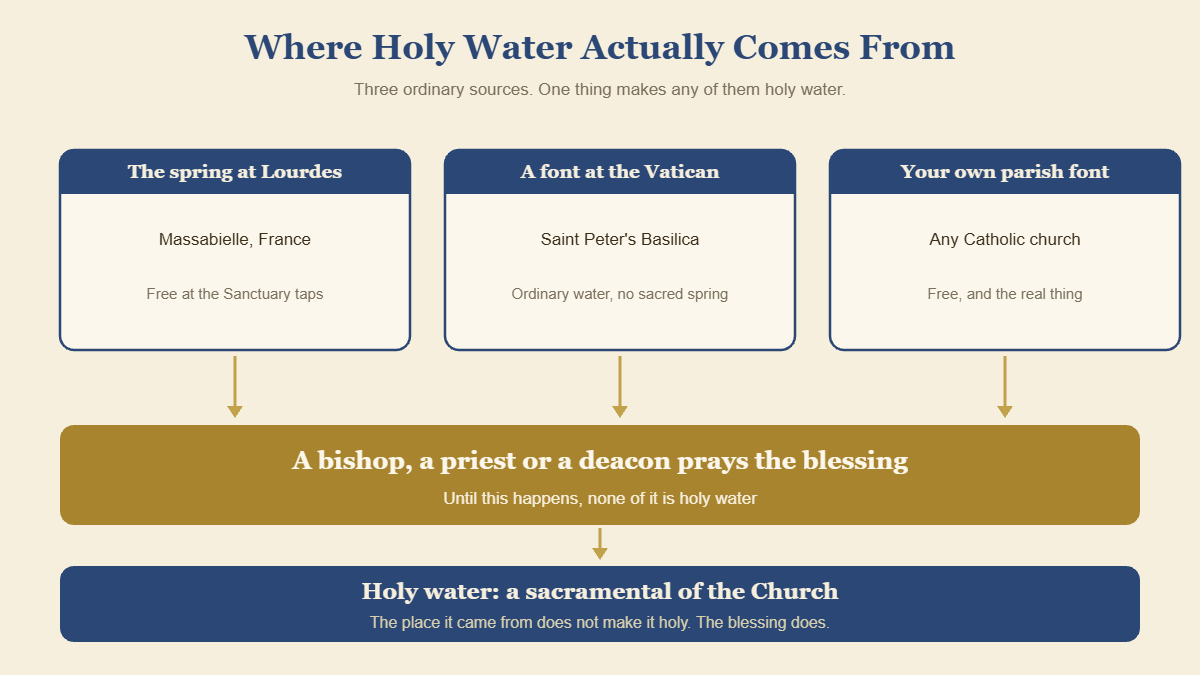
Here is the whole matter, the same point the Sanctuary of Lourdes makes about its own spring. Water becomes holy water when the Church prays over it. Not one moment before.
The minister is a bishop, a priest, or a deacon. He prays the blessing, and the water is a sacramental from that point. The Catechism is careful here. Sacramentals do not confer grace the way the sacraments do. They dispose us to it.
So the place the water came from does not make it holy. The blessing does. Rainwater in a clean bucket, blessed by a priest, is holy water. Water from a Vatican tap, never blessed, is not. We walked through the rite in our piece on the blessing of holy water prayer, and this is why holy water from the Vatican is no different in kind from the water in your own parish font.
The Real Lourdes Connection Inside the Vatican
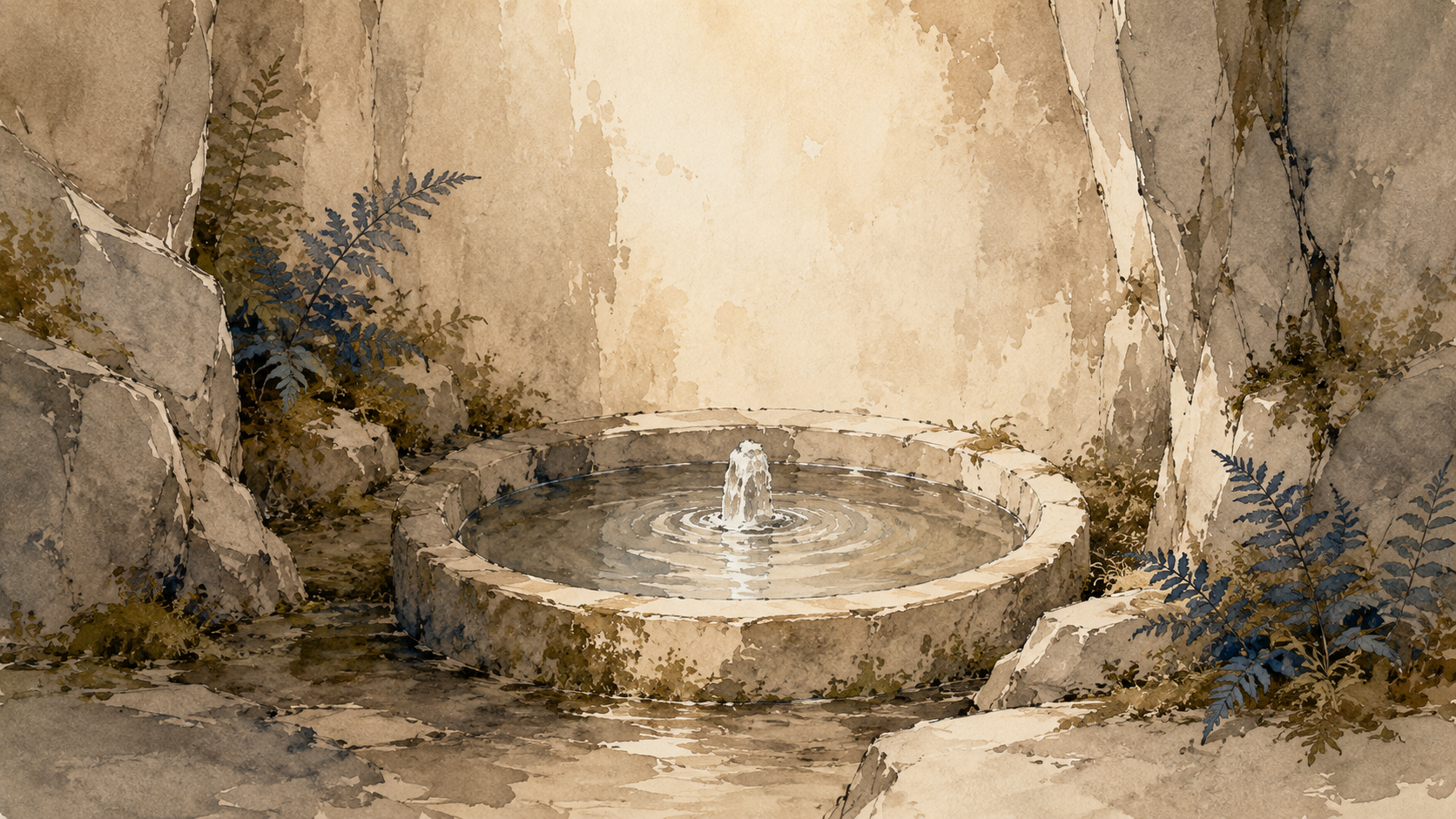
Back to that grotto, because it is the loveliest thing in this story. In 1902 Bishop Francesco Saverio Schoepfer of Tarbes presented Pope Leo XIII with a faithful, life size reproduction of the grotto at Lourdes. Built in concrete to a design by the architect Costantino Sneider, it was inaugurated by Pope Saint Pius X in 1905. It holds a statue of Our Lady of Lourdes and the original marble altar from the French grotto, given to Pope John XXIII on the hundredth anniversary of the first apparition.
The Vatican Museums describe it as a hidden and secluded place set aside for prayer. That is the honest Lourdes connection in Rome. Not a bottling plant. A place to kneel. The water still comes from the spring at Massabielle, where it always has.
What a Papal Blessing Actually Covers
At the Wednesday general audience, when the pope is in Rome, he gives the apostolic blessing at the close. It reaches the people in the square, their families at home, and the religious articles they carried in. Rosaries, medals, crucifixes, small statues, held up over their heads. A bottle of water in that crowd is included, and it costs nothing.
The Office of Papal Charities also prepares parchment blessings for weddings, ordinations and anniversaries, requested through its own site, elemosineria.va. No other website is authorized.
Notice what is absent. There is no Vatican office whose work is to fill bottles and post water to the faithful. Lourdes does that, freely, at its taps. Rome does not.
Bottles Sold as Holy Water from the Vatican
Search the phrase and sellers appear, offering small vials with a papal photograph on the label and an assurance that the Holy Father blessed the contents himself. Slow down there, and not only over the money.
The Church’s rule is old and simple. An object may be sold. A blessing may not. Simony takes its name from Simon the magician in Acts, who tried to buy the power he saw at work in Peter. A seller may fairly charge for the bottle, the label and the postage. The moment the price is justified by the blessing, something has gone crooked.
Outright fraud shows up too. In a recent Holy Year crackdown, Italian police seized roughly 3,500 counterfeit apostolic blessing parchments sold to pilgrims near Saint Peter’s Square. Fact checkers separately debunked a video, generated by artificial intelligence, of a priest advertising Vatican holy water as a remedy for illness. He never said it. Holy water is not medicine, and nobody honest will tell you otherwise.
How to Get Holy Water You Can Trust
The good news is how ordinary the answer is.
- Your own parish. Most churches keep a font by the door. Bring a clean bottle and fill it. Free, and the real thing.
- Ask your priest. If there is no font, just ask. Priests bless water gladly and it takes minutes.
- A shrine you visit. Lourdes gives its water away at the taps by the Grotto. Many shrines do the same.
- An honest seller. You pay for the bottle, the water and the shipping. No claim about what it will do for you.
Our own bottles are hand collected at the Grotto in Lourdes and sent through our Etsy shop, with the handwritten prayer sets on the shop page. We charge for the bottle, the care and the postage. Never for a blessing. Our buyer’s guide covers what a trustworthy listing looks like anywhere, and The Daily Amen, our prayer email, is free.

Keeping It at Home
Put it somewhere your hand passes. A shelf by the front door beats a cabinet, because a font you never touch becomes an ornament. Glass, kept cool, holds up best. More in our guide to using holy water at home.
One honest word before you go. Holy water is a devotional keepsake, not for drinking and not for medicinal use, and no outcome is promised with it. The Church has never taught that any water, from Rome or Lourdes or your parish font, carries power of its own. It works through the prayer of the Church and the faith of the one who uses it.
Key Takeaways
- The Vatican has no sacred spring. The fonts in Saint Peter’s hold ordinary water a priest has blessed.
- It becomes holy water through the blessing of a bishop, a priest or a deacon, never through the place it came from.
- The Vatican Gardens hold a replica of the Lourdes grotto, inaugurated in 1905, but it is a place of prayer, not a water source.
- Objects may be sold. Blessings may not. Treat any price justified by a blessing as a warning sign.
Frequently Asked Questions
Can you take holy water home from Saint Peter’s Basilica?
The fonts there are for blessing yourself as you enter, not for filling containers, and the basilica is crowded. For water from Rome, a quieter parish church is the courteous place to ask.
Is water blessed by the pope holier than water blessed by my parish priest?
No. Same rite, same blessing. The pope is a bishop, and the prayer he prays over water is the prayer your pastor prays.
How do I request an apostolic blessing parchment?
Through the Office of Papal Charities at elemosineria.va. No other site is authorized to take requests.
Does holy water from Lourdes come from the Vatican?
No. It comes from the spring at the Grotto of Massabielle in southwest France, where the Sanctuary gives it away freely at its taps. Rome’s link to Lourdes is the replica grotto in its gardens.
The Vatican Museums page on the Lourdes Grotto is the official account of it. For how the Church’s use of water grew out of Scripture, see is holy water in the Bible.