
Type “holy water” into a search bar and you get thousands of results in about a second. Bottles with wax seals. Vials with certificates. Listings promising water straight from a spring in France, at your door by Friday.
Some of those sellers are careful, prayerful people. Some are selling tap water with a pretty label.
Telling them apart is easier than it looks. It starts with a question that has nothing to do with price: does the seller understand what they are actually allowed to sell you? If you’ve been wondering where to buy holy water online without being taken for a ride, start there.
What “Authentic” Actually Means
Authentic gets thrown around loosely in listings, so it helps to pin down. For water from a shrine, it means two things stacked together. The water genuinely came from that place, and a priest or deacon blessed it. The blessing is what makes water holy water. Spring water on its own, however beloved the spring, is still spring water.
That catches people off guard. The Sanctuary of Lourdes says it plainly on its own site: water from the spring is not holy water, and becomes holy only through the action of a priest.
So when a listing uses the word authentic, ask which half it means. A seller who knows the difference will explain both without being pushed. A seller who doesn’t will just say the word louder.
You Pay for the Bottle, Never for the Blessing
Blessings are not for sale, and they never have been. The Church calls the buying and selling of spiritual things simony, after Simon the magician in the Acts of the Apostles, who offered money for the power he had watched the apostles use. Peter’s answer was not gentle.
That doesn’t mean money can never change hands. It draws a line through the middle of the transaction. A seller may charge for the glass, the stopper, the hours spent collecting and filling, and the postage to your door. Nobody may charge for the blessing, or the grace behind it.
Shrines around the world already work this way. The container and the labor carry a price. The water and the blessing are given.
Lourdes is the clearest case. Water from the spring at Lourdes is free at the taps and cannot be sold, and the Sanctuary states that flatly on its official page about the water. So anyone offering Lourdes water for a price is charging you for the bottle and the trouble of getting it to you. An honest seller says so out loud instead of hoping you never ask.
Where to Buy Holy Water Online: Four Places Worth Your Trust
Before you spend a cent, try the free routes. We covered all of them in our guide to where you can get holy water. Here’s the short version for anyone deciding where to buy holy water today.
- Your own parish, first. Most keep a font or a jug near the entrance and will gladly fill a clean bottle for you, free. Not an online option, but worth one phone call before you open a shopping cart.
- Volunteer groups tied to a shrine. Our Lady of Lourdes Hospitality North American Volunteers mails two small bottles of Lourdes water at no charge and asks you to allow four to six weeks. The Lourdes Center in Boston, run by the Marist Fathers, will also send two.
- Established Catholic retailers. The bigger stores sell fonts, bottles, sprinklers, and sometimes water. Read the product page and see whether it draws a line between the container and the blessing. The good ones do, in writing.
- Small sellers who collect the water themselves. The best sourcing usually lives here, and so does the worst. It comes down to one thing: will the person tell you where the water came from and who blessed it?
That last group is where our own shop sits. Read us with the same suspicion you would use on anybody else.
Red Flags That Should End the Sale
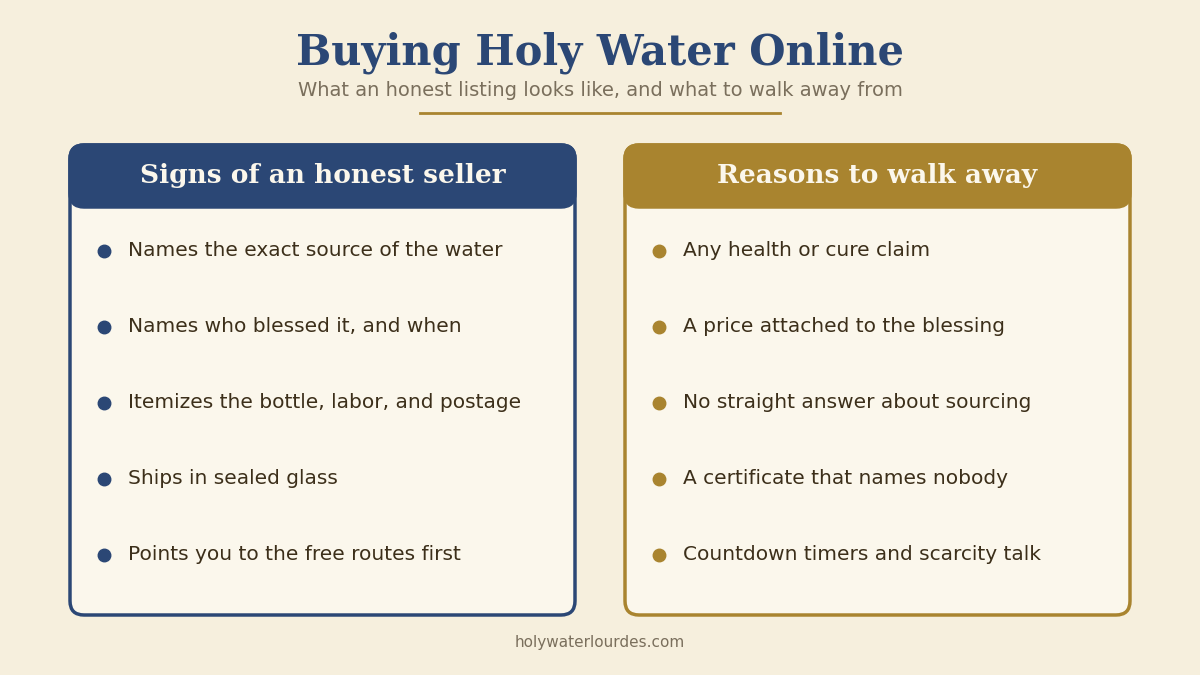
- Any health claim, of any size. The Sanctuary of Lourdes states the water has no therapeutic properties, and Bernadette Soubirous said it would have no virtue without faith. A seller promising a cure is either badly informed or dishonest. Close the tab.
- A price attached to the blessing. If a listing charges extra for blessed water over unblessed, or sells a blessing as an upgrade, that is precisely what the Church forbids.
- No straight answer about sourcing. Ask where the water came from and who blessed it. Vagueness is itself an answer.
- A certificate that names nobody. Certificates of authenticity are cheap to print. One naming no shrine, no parish, and no priest is decoration.
- Countdown timers and scarcity talk. Pressure selling has no business near a sacramental.
Four Questions to Ask Before You Buy
- Where exactly did this water come from?
- Who blessed it, and when?
- What am I paying for, item by item?
- What will it arrive in, and will it be sealed?
Anyone doing this honestly can answer all four in a couple of sentences. The third is my favorite test. A seller who itemizes the bottle, the labor, and the shipping understands the rule. One who answers with adjectives doesn’t.
The fourth matters more than people expect. Glass keeps better than plastic, and a seal tells you nothing was opened in transit. More on that in our guide to choosing a holy water bottle.

How We Handle It
We collect Our Lady of Lourdes water and send it out in sealed glass, in four sizes from two ounces up to sixteen. What you pay covers the glass, the seal, the collecting and filling, the handwritten prayer card if you choose a gift set, and the postage. The water and the blessing are not for sale and never will be. Sizes and sets are on our home page, and checkout runs securely through our Etsy shop.
One thing more, said plainly. Holy water is a devotional keepsake, a religious curio, not for drinking or medicinal use, and we promise no outcomes. It is a sacramental. It calls you to prayer and reminds you of your baptism. That’s the whole of what it is, and it’s plenty. We went further into that in our piece on whether you can drink holy water.
Want a short prayer in your inbox each morning? The Daily Amen list is free to join, and members hear first when a new batch is collected.
Key Takeaways
- Authentic means two things: the water came from where the seller says, and a priest or deacon blessed it.
- You may be charged for the bottle, the labor, and the postage. You may never be charged for the blessing.
- Lourdes water is free at the Sanctuary taps and cannot be sold, so any price covers packaging and effort.
- Try your parish and the free volunteer groups before you spend anything.
- Walk away from health claims, vague sourcing, empty certificates, and pressure selling.
Frequently Asked Questions
Is it a sin to buy holy water?
No, not when what you’re buying is the bottle and the work of getting it to you. The sin the Church names is simony, trying to buy or sell the spiritual thing itself. Paying a fair price for glass, labor, and postage is ordinary commerce.
Can holy water be sold at all?
The water and the blessing are given, never sold. The container and the service around it may be priced. It’s the same distinction the Vatican uses with blessed rosaries: the beads carry a price, the blessing does not.
Is holy water for sale online ever genuine?
Often, yes. Plenty of small sellers and parish shops do this carefully, and knowing where to buy holy water safely is mostly a matter of asking. The test is not the price or the packaging. It’s whether the seller will name the source, name who blessed the water, and itemize what your money buys.
How should I store holy water once it arrives?
Keep it in glass, somewhere cool and out of direct sun, with the cap on. A shelf by the front door or beside a home altar puts it where you’ll actually reach for it. Our guide to using holy water at home covers the everyday practices.