
A plastic jug sits on a table outside the sacristy on a Saturday morning. Nobody looks at it twice. Then the priest prays over it for about ninety seconds, and that water gets carried home in little bottles and kept by a front door for ten years.
So what happened in those ninety seconds?
We get some version of that question every week. If holy water is water plus words, which words are they, who may say them, and what does the Church actually claim changes? Once you have read the blessing of holy water prayer for yourself, most of the folklore around it quietly falls away.

What the Blessing of Holy Water Prayer Actually Says
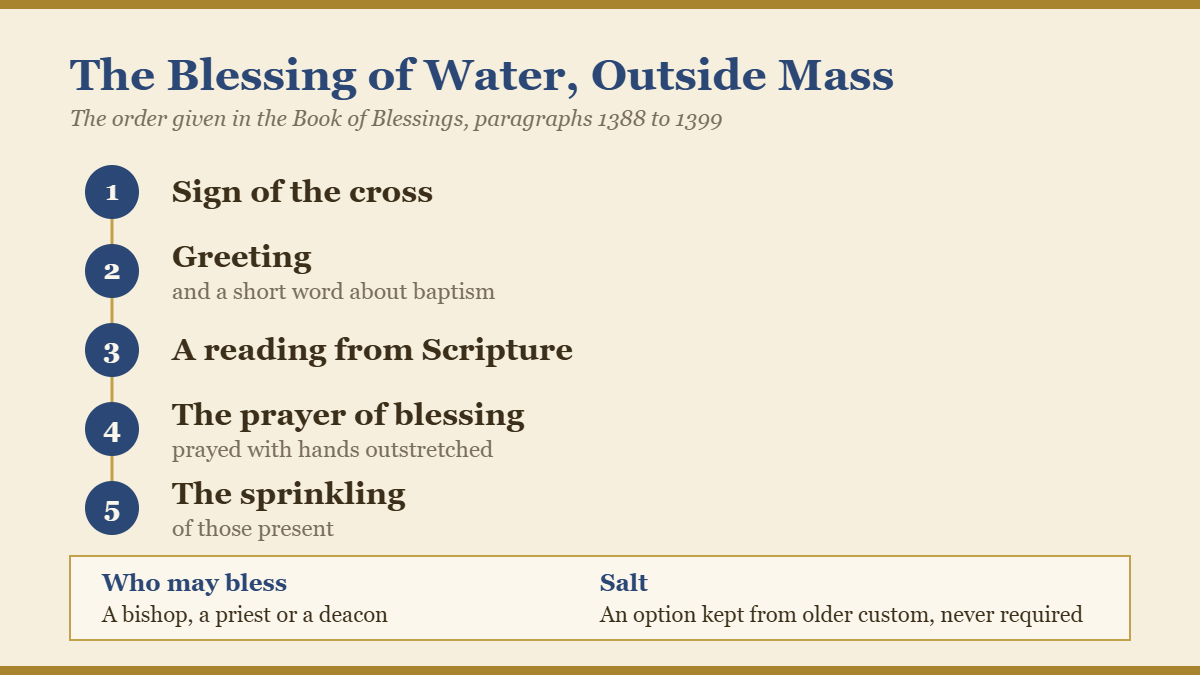
The current rite lives in the Book of Blessings, at paragraphs 1388 to 1399. Outside of Mass a priest or deacon follows that order. It opens with the sign of the cross and a greeting, then gets to the point.
He may first say what is about to happen: that this blessing reminds us of Christ, the living water, and of baptism, in which we were born of water and the Holy Spirit. Then, hands outstretched, he prays it. One approved form reads:
Blessed are you, Lord, all powerful God, who in Christ, the living water of salvation, blessed and transformed us. Grant that, when we are sprinkled with this water or make use of it, we will be refreshed inwardly by the power of the Holy Spirit and continue to walk in the new life we received at baptism.
Read it twice and notice what it never asks for. Not power stored in the water. Not protection from illness. It asks that those who use the water be renewed in their baptism. That is the whole engine of this sacramental.
Who Can Bless Water, and Who Cannot
Canon law is direct. The minister of a sacramental is a cleric with the necessary power, which in practice means a bishop, a priest, or a deacon. The Book of Blessings says outside Mass the rite may be used by a priest or a deacon.
A layperson cannot bless water, however devout. That sounds strict until you see why. A blessing is the prayer of the whole Church, spoken by someone ordained in her name.
Here is the part people miss. Once the water is blessed, any baptized person may use it freely. A mother tracing a cross on her child’s forehead at bedtime is doing exactly what the Church hopes for. She is not blessing the water. She is using water the Church blessed, and praying while she does. The words for moments like that are in our guide to holy water prayers for home.
Why Some Priests Add Salt and Others Skip It
Salt trips people up. A grandparent insisted that real holy water has salt in it, and now you wonder about your own bottle.
It is fine. The third edition of the Roman Missal keeps salt as an option, not a requirement. Where local custom suggests preserving it, the priest may bless salt first, asking God to bless the salt he created, recalling that God told the prophet Elisha to cast salt into water so that impure water might be purified. He then pours it in without saying anything at all.
That points back to the second book of Kings, where Elisha throws salt into a bad spring at Jericho. The Book of Blessings never mentions salt at all. Water blessed without salt is every bit as blessed.
The Rite in Plain Order
Stripped to the bones, a blessing outside Mass runs like this.
- The sign of the cross.
- A greeting, then a short word about baptism.
- A reading from Scripture.
- The prayer of blessing, hands outstretched.
- The sprinkling of those present.
Three quiet minutes on a weekday, or something fuller with singing on a Sunday. At Mass, especially in Easter, the blessing and sprinkling can replace the Penitential Act. If you have ever been sprinkled from the aisle on an Easter morning, that was this.
The Older Rite Some People Remember
If you grew up before the liturgical reforms, you may remember something longer and sterner. In the older Roman Ritual the priest exorcises the salt, then the water, then mixes the two, praying about putting the enemy to flight. That rite is still prayed in the traditional form.
Both are real blessings of the Church. The older text leans on deliverance, the current one on baptism. Only the emphasis moved. None of this is modern. The earliest known Latin formulas for blessing water sit in the Gelasian Sacramentary, compiled near Paris around the year 750.
What the Blessing Does, and What It Does Not Do
Holy water is a sacramental, not a sacrament, and the Catechism is careful about the difference. Sacramentals do not confer grace the way the sacraments do, but by the Church’s prayer they prepare us to receive grace and dispose us to cooperate with it.
So the water is not charged with anything. Nothing measurable happens to it in the jug. The Church sets it aside and attaches her prayer to it, so that every time you dip your fingers in you remember your baptism.
Which is why we put the same line on everything we write. Holy water is a devotional keepsake, a religious curio. It is not for drinking and not for medicinal use, and we promise no outcomes. The Church promises no cure, and neither do we.

How to Ask Your Priest to Bless Water
Easier than most people expect. A parish priest is asked constantly.
- Bring a clean container with a lid. Glass is best.
- Ask after a weekday Mass, or ring the parish office.
- Check the entrance first. Many parishes keep a filled tank by the door.
- Never offer money for the blessing itself. Pay for a bottle or postage, never for the prayer.
- Watch for the Easter Vigil, when water is blessed in every parish.
If your parish cannot help, other honest routes are in our guide on where to get holy water.
Water from Lourdes and the Same Short Rite
People assume Lourdes water is a special category with its own rules. It is not. The Sanctuary gives the water away free at its taps, and says plainly that the spring water is not holy water until a priest blesses it. Same book, same prayer. The story of holy water from Lourdes fills in the history.
Ours is collected by hand at Lourdes and prayed over before it ships. What you pay for is the glass, the seal, the packing and the postage. The sizes and the handwritten prayer sets are on our home page and in our Etsy shop.
Key Takeaways
- The blessing of holy water prayer asks that those who use the water be renewed in their baptism.
- Only a bishop, priest or deacon may bless water. Any baptized person may use it.
- Salt is an option kept from older custom. Water without salt is fully blessed.
- The older Roman Ritual, with its exorcism of salt and water, is still prayed today.
- Holy water is a keepsake rather than a medicine, and no outcomes are promised.
Frequently Asked Questions
Can I bless holy water myself at home?
No. The blessing belongs to a bishop, priest or deacon. What you can do is use blessed water, sprinkle it, bless your family with it, and pray while you do. Our guide to using holy water at home covers a dozen ways.
Does the blessing have to be in Latin?
No. It is prayed in the language of the people in the ordinary form, and in Latin in the traditional form. Both are the prayer of the same Church.
Can a deacon bless water?
Yes. The Book of Blessings names a priest or a deacon outside Mass. At Mass, the Missal gives the rite to the priest.
Does holy water stop being blessed after a while?
The Church sets no expiry. Water that has gone cloudy should be poured reverently onto the earth rather than down a drain, and the bottle refilled. Keep it capped, cool and out of the sun.
For a short prayer in your inbox each morning, and first word on a new hand collected batch, our Daily Amen list is a quiet place to start.