
Someone comes home from the Holy Land with a small bottle in a suitcase. It sits in a drawer for a year. Then a grandchild is baptized, the bottle comes out, and half the family quietly wonders the same thing. Is this really holy water, or is it river water with a nice label?
The answer has two halves that usually get tangled together. The Jordan is one of the most important rivers in Scripture. But water dipped out of it is not automatically holy water, no matter which bend it came from.
Once those two facts sit side by side, holy water from the Jordan River makes a great deal more sense, and telling an honest seller from a careless one gets much easier.

Why the Jordan Runs Through So Much of Scripture
The river keeps turning up at the hinge points, as we noted in is holy water in the Bible. In Joshua, Israel crosses the Jordan on dry ground into the promised land, and twelve stones go up so nobody forgets it (Joshua 3 and 4).
Centuries later Elijah strikes the water with his rolled cloak and walks across (2 Kings 2). Naaman the Syrian commander is told to wash seven times in the Jordan and is insulted by it, because he expected something grander than a muddy provincial river (2 Kings 5). Scripture tells that one as an account of obedience. The Church has never taught that the river itself carries any power, and we promise nothing about outcomes.
Then comes the moment the rest of it points toward. John is baptizing at the river, Jesus walks down into the water, and the heavens open (Matthew 3, verses 13 to 17). John’s Gospel names the spot: Bethany beyond the Jordan (John 1, verse 28). Christians have read that scene ever since as the moment ordinary water was set apart for holy use.
Where the Baptism Actually Happened
Ask three pilgrims where Jesus was baptized and you get three answers, so know the map first.
Al Maghtas, on the Jordanian bank, is the site UNESCO added to the World Heritage List in 2015 as Bethany beyond the Jordan. Archaeologists there have uncovered churches, chapels, hermit caves, and a baptistery. Three popes have made the pilgrimage: John Paul II, Benedict XVI, and Francis.
Across the water, near Jericho, is Qasr al Yahud, where the Franciscans have made an annual pilgrimage since at least 1641. The area was closed as a military zone after 1967 and reopened in 2011. Like Lourdes, both public baptism sites are free to visit and the water is free to touch.
Further north, where the river leaves the Sea of Galilee, sits Yardenit. It is a modern site drawing hundreds of thousands of visitors a year and sells bottled Jordan River water in its own shop. Worth knowing, because water sold as from the Jordan may have been drawn far upstream. Nothing wrong with that. Something wrong with not saying so.
When River Water Actually Becomes Holy Water
Here is the rule that clears up the confusion. Water becomes holy water when a bishop, a priest, or a deacon blesses it. Geography does not do it, and a label certainly does not.
The Sanctuary of Lourdes says exactly this about its own famous spring. The same goes for holy water from the Jordan River. A bottle filled at the baptism site and never blessed is a moving souvenir, and that is all it is until the prayer is said over it.
The Catechism calls blessed water a sacramental. It does not confer grace the way the sacraments do, but disposes us to receive it through the prayer of the Church rather than through anything in the water.
If you own a bottle and have no idea whether anyone blessed it, the fix takes five minutes. Ask your parish priest after Mass. The rite is in the blessing of holy water prayer.
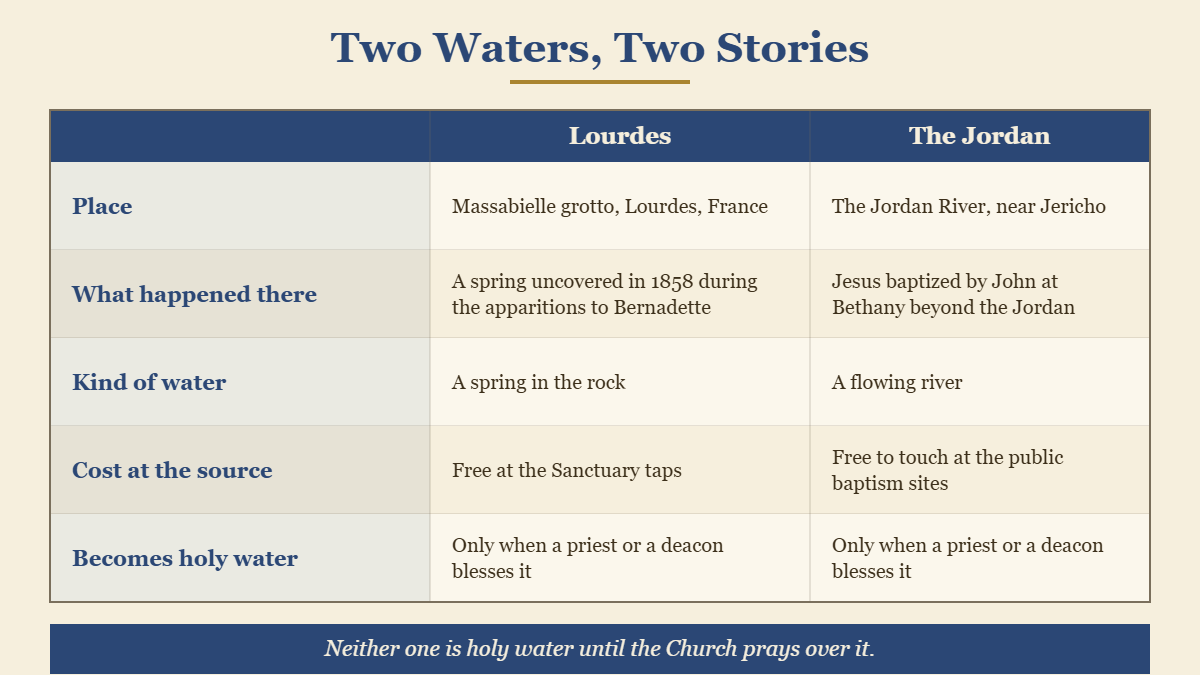
Holy Water from the Jordan River Compared With Lourdes Water
People often treat the two as interchangeable. The difference comes down to what happened at each place.
At Lourdes, a spring was uncovered at the grotto of Massabielle in 1858, during the apparitions to Bernadette Soubirous. The Sanctuary gives that water away free at its taps and states plainly that it has no therapeutic properties. That story is in holy water from Lourdes. At the Jordan, the water marks the place where Christ stepped into a river and was baptized.
Neither outranks the other. Keep a small bottle of each and you hold two chapters of one story: the river where the Lord was baptized, and a mountain spring where a poor girl was told to go and drink.

How to Keep It and Use It at Home
Treat it the way you would any blessed water, because once a priest has prayed over it, that is what it is.
- Keep it in glass, somewhere cool and out of direct sunlight.
- Bless yourself on the way out the door and again when you come home.
- Trace a small cross on a child’s forehead at bedtime.
- Return what you do not use to bare earth or a church font, never the sink.
A father I know keeps his in the coat closet by the door, the one spot the household passes through. It gets used. A bottle in a display cabinet never does. There are a dozen more practices in how to use holy water at home.
One honest note, which we say about everything on our shelf. Holy water is a devotional keepsake, not for drinking and not for medicinal use, and no outcomes are promised. It is a sign pointing back to baptism. The drinking question gets untangled in can you drink holy water.
What to Check Before You Buy a Bottle
Most holy water from the Jordan River is sold by decent people, but the market has careless corners. Four questions sort it out.
- Does the seller say plainly where the water was drawn?
- Does the seller say whether a priest blessed it, and roughly when?
- Does the listing promise anything? A page promising healing, luck, or protection is telling you what kind of seller it is.
- Is the price for the bottle, the packing, and the postage, rather than for the blessing?
That last one matters. Selling a blessing is called simony, and the Church has forbidden it since the Acts of the Apostles. Charging for a bottle, a label, and shipping is ordinary commerce. Charging for the grace is not.
That is the standard we hold ourselves to. Our own water is hand collected at Lourdes and sent out as a devotional keepsake, in four sizes and in the handwritten prayer sets, on our home page and in our Etsy shop. Still weighing your options? Six honest ways to find holy water covers the parish, the shrine, and the post. And the Daily Amen list will send you a short prayer each morning, free.
Key Takeaways
- The Jordan is where Israel crossed into the promised land and where Jesus was baptized.
- River water is not holy water on its own. A bishop, priest, or deacon has to bless it.
- The traditional baptism site sits at Al Maghtas and Qasr al Yahud, near Jericho.
- Buy from anyone who says where the water came from and promises you nothing.
Common Questions
Is water from the Jordan River automatically holy water?
No. It is water from a deeply significant place, which is no small thing, but it becomes holy water only when a bishop, priest, or deacon blesses it.
Can my parish priest bless a bottle I brought home myself?
Yes, and most are happy to. Bring it after Mass and ask. The blessing of water outside Mass is short, and no fee is ever charged.
Can Jordan River water be used at a baptism?
That is up to the parish and the priest. Some are glad to add a little to the font. Ask well before the day, not on the morning of.
Is Jordan River water better than Lourdes water?
Neither is better. Once blessed, both are simply holy water. Choose the story that draws you closer to prayer. For the Church’s own account of the place, the Vatican’s page on Bethany beyond the Jordan is a good short read.