The boxes are still stacked in the hallway. Somebody has lost the box cutter, the kitchen smells faintly of paint, and you are standing in a house that does not quite feel like yours yet.
That is the moment Catholic families reach for a small bottle of holy water. It is an old instinct. Long before the housewarming party existed, Christians walked through a new dwelling praying in every room.
Here is the part that surprises people. You do not have to wait for a priest. The Church’s own ritual book, the Book of Blessings, gives a form for a lay minister, so a mother or father can lead this prayer today.
What follows is how to bless your home with holy water, room by room, in a way that is reverent, correct, and simple enough to do with children underfoot.
What a Home Blessing Is, and What It Is Not
Holy water is a sacramental, not a sacrament. Baptism does something definite that Christ himself instituted. A sacramental is a sacred sign the Church gives us that stirs up prayer and disposes us to receive grace.
That distinction saves you from a mistake. A house blessing is not a seal you install, and it does not put a shield around your roof. It is an act of prayer, offered by a family in the rooms where they cook, argue, sleep, and forgive each other.
The water helps because it is physical. When the Church sprinkles anyone she says plainly what it means: the water calls to mind the baptism that already claimed you for Christ.
What You Need Before You Start
To bless your home with holy water you need very little, and none of it is expensive.
First, real holy water. Water becomes holy water when a priest or a deacon blesses it. No amount of sincerity on your part turns tap water into a sacramental, so if you are not sure where yours came from, get a fresh supply.
Second, something to carry it in. A small glass bowl works, and so does the bottle itself. An aspergillum is the traditional sprinkler, but your fingers are perfectly acceptable, and a sprig of evergreen dipped in the bowl is an old custom that children love.
Third, and this one matters, the people. The Book of Blessings is firm: there is no blessing of a new home unless those who will live in it are present. Gather everybody. The blessing is for them, not for the drywall.
Room by Room: How to Bless Your Home with Holy Water
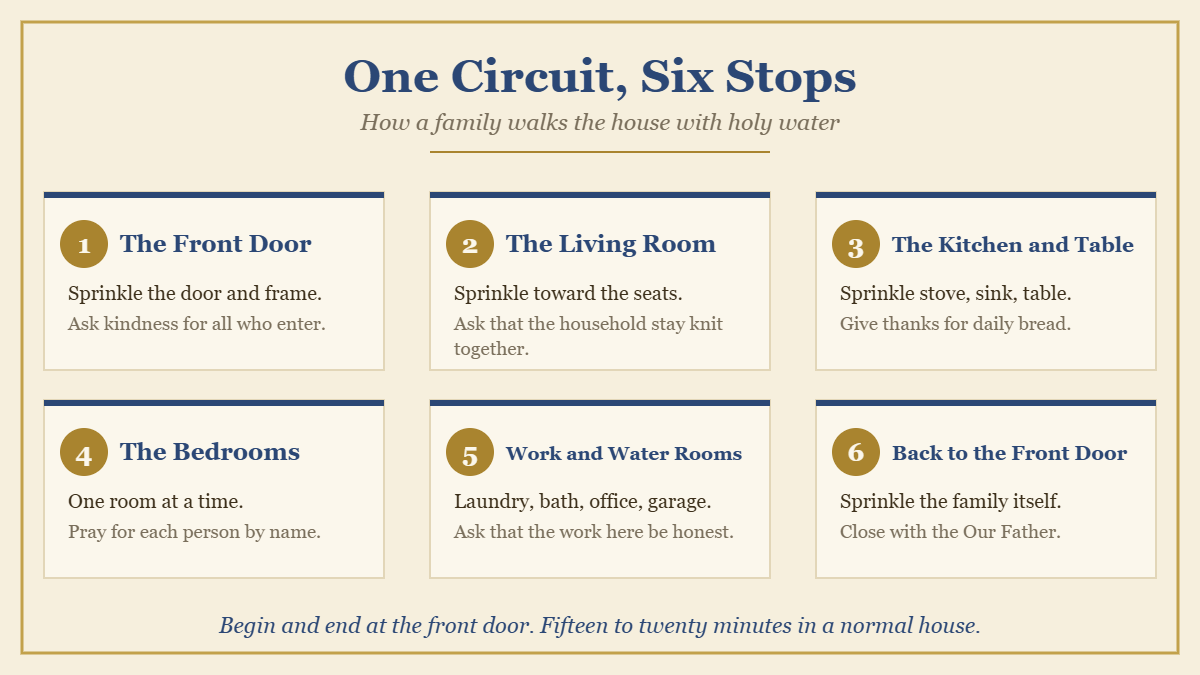
Walk the house in one unbroken circuit so nothing gets skipped and nobody wanders off. Begin at the front door and end there. Read a short passage of Scripture aloud before you set out. Luke 19, the story of Zacchaeus welcoming Christ into his house, sets the tone in about forty seconds.
Start at the front door
Stand together at the entrance. Sprinkle the door and the frame, and trace a small cross on the lintel if you like. Pray that everyone who crosses this threshold, family and stranger alike, meets kindness here.
The living room
This is where the household actually happens. Sprinkle toward the center of the room and the seats where people sit, and ask that the people who share it be knit together rather than driven apart.
The kitchen and the table
Sprinkle the stove, the sink, and the table. The old prayers here are about daily bread and gratitude, which is a healthy thing to say out loud in front of children. Bless a separate dining room in the same breath.
The bedrooms
Go one at a time, sprinkling toward the bed and the window. This is usually where a blessing turns personal, because a parent ends up standing in a doorway praying for one particular child by name. Let each person say something in their own room.
The work rooms and the water rooms
Laundry, bathroom, office, garage, basement. People skip these and they should not. Ask that the work done here be honest work, and that these plain rooms serve the household well.
Finish where you began
Come back to the front door and sprinkle the family itself, gently, the way the priest does at Mass. Then say the Our Father together. The whole circuit takes fifteen or twenty minutes.

What to Pray as You Go
You do not need a script, but a few good lines help when your mind goes blank. While sprinkling, the Church’s own words are hard to improve on: let this water call to mind our baptism into Christ, who has redeemed us by his death and resurrection.
At the entrance, ask God to protect our going out and our coming in. In the kitchen, thank the God who fills the hungry with good things. In a bedroom, ask for rest through the night.
One small rubric worth knowing: a layperson prays these blessings with hands joined, while a priest or deacon prays them with hands outstretched. Near the Epiphany, many families also chalk the doorway with the year and the letters C, M, and B, which stand both for the traditional names of the magi and for the Latin phrase asking Christ to bless this house.
We collected a longer set of words in our guide to holy water prayers.
When to Ask a Priest Instead
A lay led blessing is real and good, and a priest’s blessing is fuller. Ask your pastor when you move into a newly built or newly purchased home and want the formal rite. Ask when a household has been through something heavy and wants the Church present in the person of her priest. Ask when you would simply rather have him do it.
Most pastors say yes, and many bless homes freely during the Christmas and Easter seasons, since the Book of Blessings has a form for exactly that.
Keeping the Blessing After the Prayers Are Done
A blessing is not a coat of paint that wears off, but the habit behind it fades quickly if nothing reminds you.
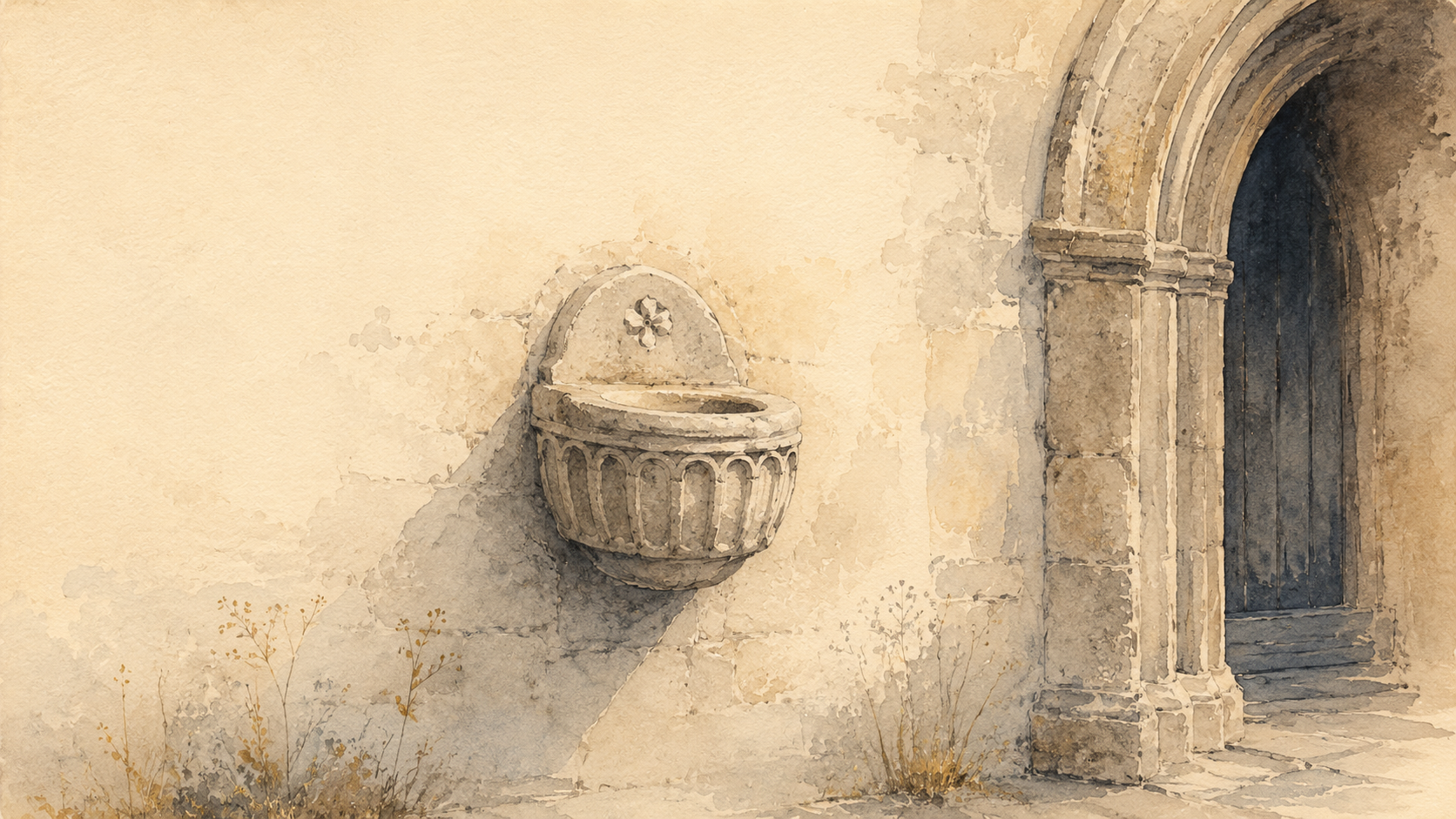
The old solution is a small font by the door. Keep a little holy water in it, bless yourself on the way out in the morning and on the way in at night, and refill it when it runs low. There are plenty of other everyday ways to use it.
Some families renew the walkthrough once a year, often at Epiphany or at the start of Lent. Others keep a bottle in the cupboard for when something calls for it: a child leaving for college, a hard week.
Our Lourdes water is drawn at the shrine in France and sent in sealed glass, and plenty of families keep a bottle for this purpose. The bottles and the handwritten prayer sets are on our home page and in our Etsy shop, and the Daily Amen list is where we send a short prayer each morning.
A reverent word before you go. Holy water is a devotional keepsake, a religious curio, not for drinking and not for medicinal use. The Church promises no outcomes, and neither do we. What a blessing offers is prayer, memory, and the sign of the cross traced over an ordinary doorway.
Key Takeaways
- A layperson may lead a home blessing using the form the Book of Blessings provides.
- Before you bless your home with holy water, make sure it was blessed by a priest or a deacon.
- Everyone who lives in the house should be there.
- Walk one circuit, start and finish at the front door, and skip no room.
- A font by the door keeps the practice alive afterward.
Common Questions
Can I really bless my own house without a priest?
Yes. The Church provides a lay form, and a parent leading prayer in their own home is on solid ground.
How much water should I use?
A few drops per room. Sprinkling is a gesture, not a soaking, and a small bottle will bless a house many times over.
Does a home blessing wear off?
No. What fades is the habit, which is why families renew the walkthrough each year.
What do I do with holy water I no longer want?
Pour it onto bare earth or into a church font, never down a drain.