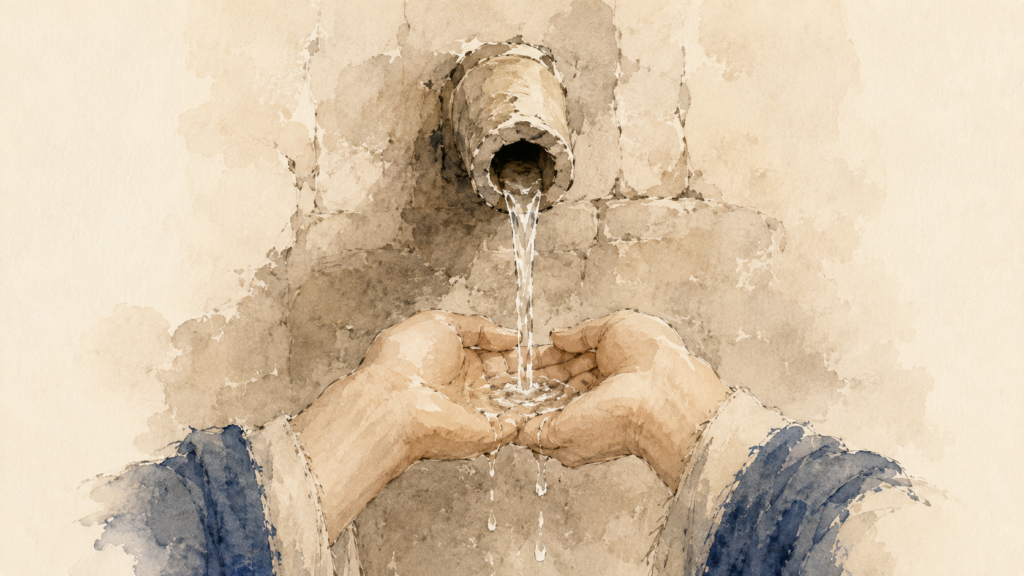
There is a small glass bottle on a shelf beside our front door. Plenty of families keep one like it, and most know the same quiet hesitation. You reach for the water, touch your fingers to it, and stop, because nobody ever taught you what to say.
You are not doing it wrong. The Church never issued one required script for the water you keep at home. It handed down something better: a few very old words that fit in the mouth of a tired parent at ten at night.
Here is what Catholics have prayed for centuries, and how to use a holy water prayer at home without letting it drift into superstition.

The shortest prayer is one you already know
Dip two fingers. Touch your forehead, your chest, your left shoulder and your right. Say the words you learned before you could read.
In the name of the Father, and of the Son, and of the Holy Spirit. Amen.
That is a complete prayer. Nothing else is required. The gesture echoes your baptism, when water was poured over you and those same three names were spoken aloud. Every time you repeat it you are saying yes to that again.
The old prayer for the washing away of sin
The words most often added are short enough to memorize on one reading.
By this holy water and by your Precious Blood, wash away all my sins, O Lord.
You will find it printed on holy cards and tucked into old missals. Some of those cards promise a set number of days of indulgence. Ignore the day counts. Pope Paul VI retired that system of days and years in 1967, and the Church now speaks of partial and plenary indulgences without the arithmetic. The prayer lost nothing.
Pray it on your way out in the morning. Pray it again when you come back in.

What a holy water prayer actually does
Holy water is a sacramental. The Catechism describes sacramentals as sacred signs that resemble the sacraments and signify effects, chiefly spiritual ones, obtained through the intercession of the Church. Then it draws a line that is easy to skim past. Sacramentals do not confer grace the way the sacraments do. By the prayer of the Church they prepare us to receive grace and dispose us to cooperate with it.
Read that twice and a lot clears up. The water is no charm. The words oblige God to nothing. The Church prays, you pray along with her, and your attention turns toward God in a moment you would have walked straight past.
St. Teresa of Avila wrote that from long experience she had found nothing like holy water to put devils to flight. Take her seriously. Also notice what she is describing. A whole life of prayer, not a trick.
A blessing for your children
Catholic parents have blessed their children this way for centuries, and it takes about four seconds. Wet your thumb. Trace a small cross on the child’s forehead. Say, in the name of the Father, and of the Son, and of the Holy Spirit. A kiss afterward is not part of any rite and is entirely allowed.
The Church’s own Book of Blessings includes a sprinkling in its blessing of children, with the line that this water should call to mind our baptism into Christ, who redeemed us by his death and resurrection. The whole meaning, in one sentence, and it holds up at your own front door at 7:40 in the morning.
Keep one distinction straight. A parent’s blessing is a real prayer, not a priestly one. You are asking God to bless your child. A priest blessing a child acts in the name of the Church in a different way. Both are good. They are not the same thing.

Blessing a room, a doorway, or a whole house
Sprinkle a little water toward the room. Make the sign of the cross. Then ask for what you actually want, in your own words. A pattern that has served many: Lord, bless this house and everyone who lives in it, and keep us in your peace.
Doorways and bedrooms are where most people start, along with whichever room somebody is worried about this week. For a longer walk through the house, see how to use holy water at home.
A yearly blessing of the home by a priest is an older and separate custom, and worth asking your parish about.
The prayers the Church prays when she sprinkles
You have heard these at Mass even if nobody named them. Outside the Easter season the sprinkling is often sung with the Asperges, which is Psalm 51. Sprinkle me with hyssop, and I shall be clean. Wash me, and I shall be whiter than snow. During Easter it gives way to the Vidi Aquam, drawn from Ezekiel 47, which sings of water flowing out from the right side of the temple.
Praying one line of either at home is entirely fitting.
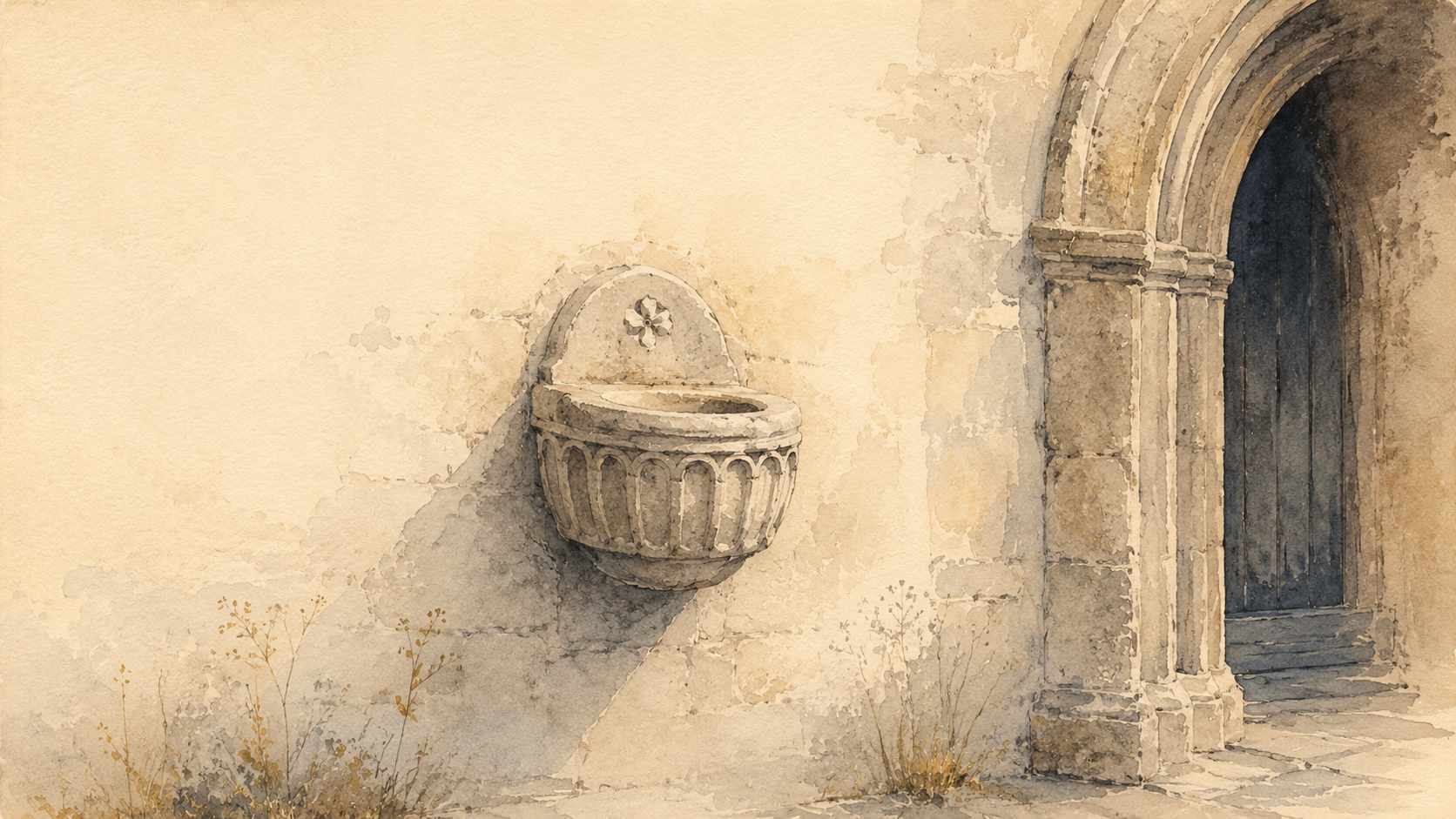
The blessing of holy water prayer itself
People often go looking for the blessing of holy water prayer hoping to bless a jug of water in their own kitchen. The honest answer is short.
Only a bishop, priest, or deacon blesses water. The prayer belongs to the ordained minister acting in the name of the Church, and that is precisely what makes the water a sacramental rather than a private good intention. A lay person praying over a glass of tap water is praying, and prayer is never wasted, but what sits in the glass is still tap water.
What you can do is ask. Most priests are glad to bless a bottle you bring to the sacristy after Mass. If you would rather have it sent, we cover the options in where can I get holy water.
Keep it where your hand can reach it
The practical trouble is never theology. It is that the bottle ends up in a cupboard behind the vases, and a prayer you cannot reach is a prayer you will not pray.
Put it by the door you actually use. A small font, a narrow shelf, whatever suits your wall. We collect our water at the Grotto at Lourdes and bottle it by hand for this exact purpose, and the sizes are on our shop page and at our Etsy shop. If you would like a short prayer in your inbox each morning, The Daily Amen is free to join.
One line we put on every listing and will keep repeating here. Our Lourdes water is a devotional keepsake, a religious curio, not for drinking and not for medicinal use. The Church promises no outcomes and neither do we. What is offered is a way to pray.
Key takeaways
- The sign of the cross with the words you already know is a complete prayer.
- The traditional line: by this holy water and by your Precious Blood, wash away all my sins, O Lord.
- Sacramentals do not work automatically. They dispose you to grace through the Church’s prayer.
- Parents may bless their children with it. Only a bishop, priest, or deacon may bless the water itself.
- Keep the bottle within arm’s reach of a door you use, or you will forget it is there.
Frequently asked questions
What is the best prayer to say when using holy water?
The sign of the cross with the words in the name of the Father, and of the Son, and of the Holy Spirit. Many people add: by this holy water and by your Precious Blood, wash away all my sins, O Lord. Either is enough.
Can I bless holy water myself at home?
No. Blessing water is reserved to a bishop, priest, or deacon. You may pray over anything you like, but water becomes holy water through the prayer of the Church offered by an ordained minister.
Do I have to say anything out loud?
No. The gesture prayed silently is still a prayer. Saying the words aloud simply helps most of us pay attention, which is the whole reason the practice exists.
Is there a prayer for blessing a house with holy water?
Sprinkle each room, make the sign of the cross, and ask God plainly to bless the house and everyone in it. For a new home especially, ask your parish priest to come and bless it.