A reader wrote to us in the spring with a problem that sounds small until you sit with it. Her mother was turning eighty, she wanted to give her a little bottle of water from a holy place, and she couldn’t decide which holy place.
One would come from a spring in the Pyrenees. The other from the river John the Baptist stood in. Both real, both sold by honest people. She only wanted to know which one belonged in her mother’s hands.
That question comes up more often than you’d think, and these two waters aren’t rival products. Once you know what each one actually is, the choice gets a lot easier.
Where Lourdes Holy Water Comes From
Lourdes holy water comes from a spring inside the Grotto of Massabielle, a hollow of rock on the edge of a market town in southern France.
In 1858 a girl of fourteen named Bernadette Soubirous saw a lady there eighteen times. On the twenty fifth of February she was told to go and drink at the spring and wash there. There was no spring anybody knew of. She scraped at the muddy floor of the grotto with her hands, water seeped up into the hollow she made, and it has been running ever since.
That water is piped now to a row of taps beside the Grotto, and pilgrims fill bottles there by the thousand. The Sanctuary gives it away for nothing and states plainly that it cannot be sold. If you can’t go yourself, somebody has to fetch it, bottle it and post it, and that work is what an honest seller charges you for.
The Sanctuary is just as plain about what the water isn’t. It says the spring water has no therapeutic properties, and Bernadette herself said it would have no virtue without faith. We keep that line exactly where the Church puts it. The fuller story is in our piece on the spring at Massabielle.
Where Jordan River Water Comes From
The Jordan is a river, not a spring, and it runs straight through Scripture. Israel crossed it on dry ground in Joshua 3. Naaman washed in it seven times in 2 Kings 5, though the point of that story is his obedience, not the river.
Then, in Matthew 3, Jesus walks down from Galilee and asks John to baptize him. John’s Gospel places it at Bethany beyond the Jordan. Christians have gone to the river to remember it ever since.
Three places on the river matter today. Al Maghtas, on the Jordanian east bank, joined the UNESCO World Heritage List in 2015 as Bethany beyond the Jordan. Qasr al Yahud sits opposite, on the west bank near Jericho. Yardenit lies far to the north where the river leaves the Sea of Galilee, draws over half a million visitors a year, and runs a shop that sells bottled water.
That geography matters when you buy. Water sold as Jordan River water is often drawn miles upstream of the traditional baptism site. Nobody is lying to you, but it’s worth knowing. Our post on holy water from the Jordan River walks through the sites one at a time.
Neither One Is Holy Water Until It Is Blessed
Here’s the part most comparisons skip.
Spring water from Lourdes isn’t holy water. River water from the Jordan isn’t holy water. Water becomes holy water when a bishop, a priest or a deacon prays the Church’s blessing over it, and not a moment sooner. The Sanctuary says exactly this about its own spring.
Once blessed, it’s a sacramental, and the Catechism is careful here too. Sacramentals don’t confer grace the way the sacraments do. By the prayer of the Church they prepare us to receive grace and dispose us to cooperate with it. That’s a real thing. It isn’t a promise about outcomes.
So the origin gives you the story and the blessing gives you the sacramental. Every bottle worth keeping needs both. You can read the actual words of the rite in our guide to the blessing of holy water.
Lourdes Holy Water or Jordan River Water: Which Fits You
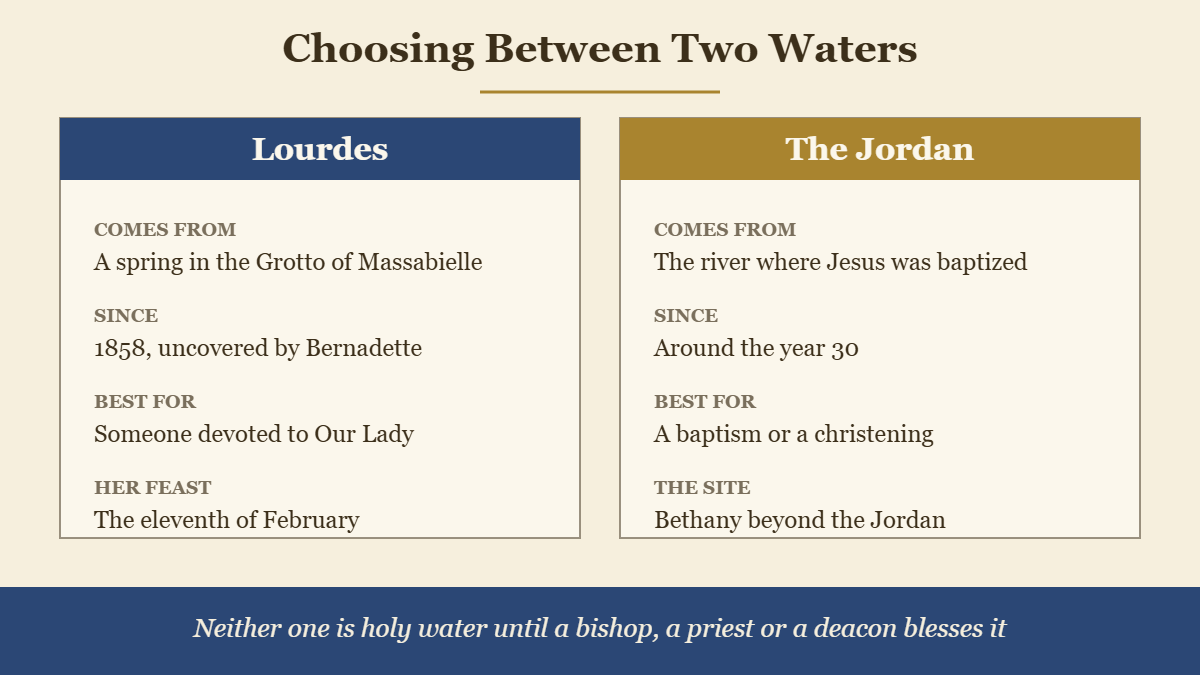
Choose Lourdes when the person you have in mind has a devotion to Our Lady. The meaning of that spring is Marian from beginning to end. It was uncovered at her word, her feast falls on the eleventh of February, and a bottle from Massabielle says something specific about who you’re entrusting somebody to.
Choose the Jordan when the occasion is a baptism. A godparent handing over water from the river where Christ was baptized has made the connection for the child without saying a word. It suits a christening, a confirmation, or anyone drawn to the Gospels.
And you’re allowed to want both. Plenty of families keep a small bottle of each, one by the door and one put away for a grandchild. Neither water ranks above the other. One remembers a French grotto in 1858. The other remembers a river around the year 30.
What to Ask Before You Buy Either One
The same four questions work for both waters. Any decent seller answers all four without flinching.
- Where exactly was it collected, and who collected it?
- Has it been blessed, and by whom?
- Am I paying for the bottling and the postage, or for the water itself?
- Is it in glass with a proper seal, so it arrives intact?
The third one separates the honest shops from the rest. Selling a blessing is simony and the Church has forbidden it since the Book of Acts. Selling a bottle, a journey and a stamp is ordinary trade. We collect our own water at the Grotto by hand, so we can tell you where every bottle came from. Sizes and prayer sets are on our shop page and in our Etsy shop.

How to Keep It at Home
Treat either one the same way. Keep it in glass, somewhere cool and out of the sun. A shelf by the front door beats a cupboard, because a bottle you can reach is a bottle you’ll actually use.
Bless yourself coming in and going out. Bless the doorway of a new home. Our post on using holy water at home has a dozen more, and this guide covers where to find it.
One thing we say on every page and will say here. The water we sell is a devotional religious keepsake, a religious curio, and it is not for drinking or medicinal use. We make no medical or healing claims and we promise no outcomes. What we offer is a real bottle from a real place, and the prayer that goes with it. If you’d like a short prayer each morning, the Daily Amen list is free to join from the homepage.
Key Takeaways
- Lourdes holy water comes from the spring Bernadette uncovered in 1858. Jordan River water comes from the river where Jesus was baptized.
- At the Sanctuary the water is free and cannot be sold. An honest price covers bottling and postage, never the water or the blessing.
- Neither water is holy water until a bishop, a priest or a deacon blesses it.
- Lourdes suits a devotion to Our Lady. The Jordan suits a baptism.
- It’s a devotional keepsake, not for drinking or medicinal use, and no outcomes are promised.
Questions People Ask
Is one of these waters holier than the other?
No. Once a priest has blessed it, blessed water is blessed water. What differs is the story attached to the place, and that story is for you, not for the water.
Can I mix the two together?
You can, but most people would rather not. Half the point of a keepsake is being able to say where it came from.
Which one is better for a baptism gift?
The Jordan, usually, because the link to the sacrament is obvious to everyone in the room. Lourdes is the better choice if the family has a Marian devotion or a name tied to Our Lady.
Does Lourdes holy water go off?
Blessed water doesn’t expire, though water kept warm or in sunlight can cloud over time. Glass, a cool shelf and a good seal will keep a bottle clear for years. If it does go cloudy, pour it onto bare earth rather than down the drain.