
In a lot of Catholic homes there is a small bowl mounted beside the front door that has been dry for years. Nobody decided to stop using it. Someone forgot to refill it one week, then the next, and after that nobody noticed it at all.
That is the quiet problem with these little vessels. Buying one takes five minutes. Choosing one that suits your doorway and the way your family moves through the house is what decides whether it gets used or turns into wall decoration.
So here is a practical guide to picking a holy water holder, hanging it where your hand will find it, and keeping it filled. If you want the vocabulary first, meaning the difference between a font, a stoup, and a basin, we sorted that out in our guide to holy water holders for the home.
What the Holder Is Really For
The habit is older than most people assume. Medieval English churches kept shallow stone basins set into a niche near the entrance, and people blessed themselves on the way in. Catholic families carried that gesture home, keeping a small bowl by the door so they could sign themselves coming and going.
Parents used it at night as well, wetting a thumb to trace a cross on a child’s forehead before the light went out. That is why the older style of home stoup often hung at the head of the bed.
The vessel itself is not blessed and it is not holy. The water is. The bowl just keeps it where your hand expects to find it, and that takes a lot of pressure off the shopping. You are not hunting for something rare.
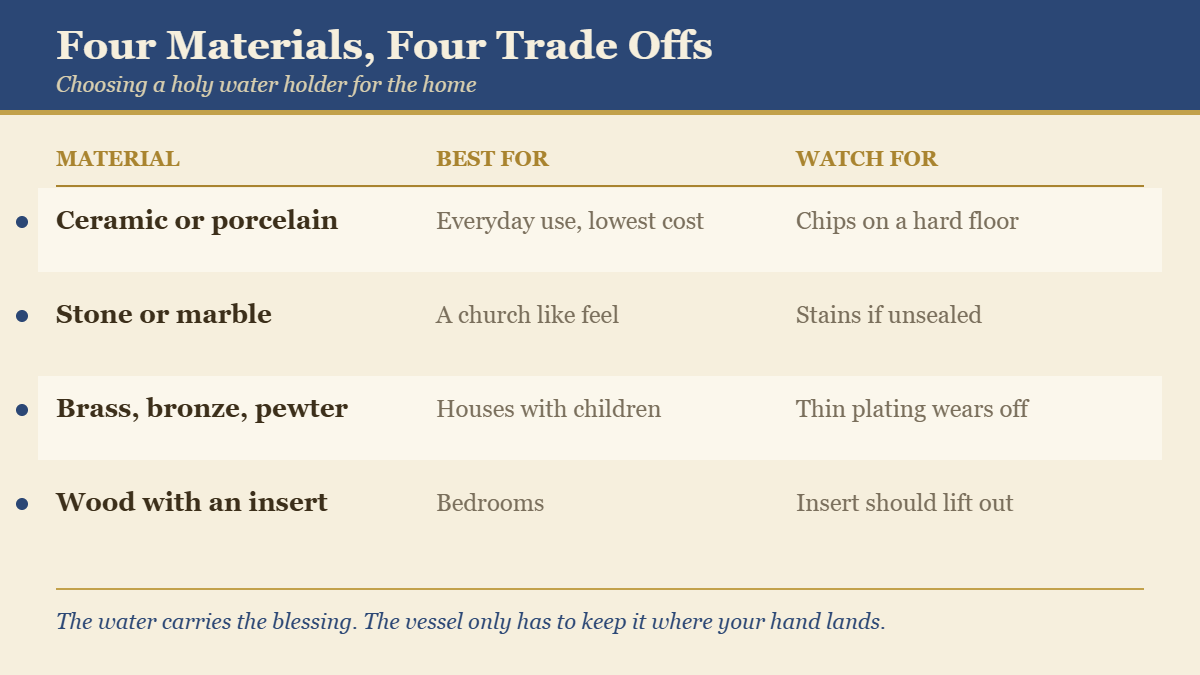
Choosing a Holy Water Holder: Four Materials
Almost everything on the market falls into one of four groups, and each behaves differently on a wall in a real house.
Ceramic and porcelain. The most common option and usually the cheapest. Glazed ceramic wipes clean, never corrodes, and comes in everything from plain white to hand painted. It also chips the moment it meets a tile floor, so think twice about a narrow hallway where a backpack swings past.
Stone and marble. Heavy, cool to the touch, closest in feel to a church. Stone is porous, so an unsealed piece can stain and keep a faint mineral ring. Look for a sealed or polished interior, and mount it into a stud or a proper anchor, not one nail in drywall.
Brass, bronze, and pewter. Nearly unbreakable and the most forgiving choice in a house with children. Brass and bronze darken with age, which some people love and others polish back. Avoid anything thinly plated, since the plating wears off exactly where fingers touch.
Wood with a glass or metal insert. The warmest looking of the four and the best fit for a bedroom. The wood never touches the water, so nothing swells or splits. Check that the insert lifts out. A fixed one is miserable to clean.
Four Things to Check Before You Buy
- The bowl only needs to be deep enough to wet a fingertip. Deeper is not better.
- See how it hangs. A keyhole slot sits flat. A single hole near the rim tends to tilt.
- Ask whether the bowl detaches. If not, cleaning means a cotton swab.
- Hold it up to the spot before you drill. Most people hang these too high.

Where to Place One So It Gets Used
Placement matters more than material, and this is where most households slip.
The traditional spot is just inside the front door, at the height your hand falls as you pass, roughly shoulder height for an adult. But the front door is rarely the door a family actually uses. In most American houses the real entrance is the one from the garage.
Picture a family of five with a formal front entry that opens twice a month. A font by that door sits untouched. Move it to the mudroom door, where five people pass eight times a day, and it becomes part of the rhythm of the house inside a week.
The bedroom is the other strong option, and the older one. A stoup by the bedroom door or above the bed fits the night prayer and makes it easy to bless a child who is already half asleep. If you want young children reaching for it themselves, hang a second one at their shoulder height and expect to refill it more often.
How to Keep a Holy Water Holder Filled
Small open bowls evaporate faster than people expect. In a dry heated house in winter, a shallow font can be empty inside a couple of weeks, which is usually how the habit dies.
Two things fix it. Keep your supply bottle right beside the font, because nobody refills anything that requires a trip to another room. Then tie the refill to something you already do. Sunday, on the way in from Mass, is the easiest anchor most families have.
Wipe the bowl out every few weeks. There is nothing irreverent about keeping the vessel clean.
What to Do With Water You Pour Out
Blessed water does not go down a kitchen sink. Pour it onto the earth instead, into a garden bed, at the base of a tree, or into a church sacrarium if your parish has one. It returns to the ground rather than the plumbing. Four seconds, and it keeps the practice honest.
Where the Water Itself Comes From
Most parishes keep a filled font or a tank in the vestibule and are glad to let you take some home. Bring a clean bottle. If nothing is out, the office will usually help. We walked through the options in where to get holy water.
Some families want their font to hold water from a place that means something to them, which is how water from the spring at Massabielle ends up in so many households. The Sanctuary at Lourdes gives that water away freely at the taps. What you pay anyone for is the collecting, the bottling, and the shipping, never the water. Ours is hand collected at Lourdes and sent through our Etsy shop in sizes that suit a small home font.
If you would like a short prayer in your inbox each morning, the Daily Amen list is free to join, and subscribers hear first when a new batch comes back from France.
Key Takeaways
- A holy water holder is a practical object, not a blessed one. The water carries the blessing.
- Ceramic is cheap, stone feels like church, metal survives children, wood suits a bedroom.
- Hang it by the door your family actually uses, at the height your hand already passes.
- Keep the supply bottle beside it and refill on a fixed day.
- Pour used water onto the earth, never down the drain.
Common Questions
Does a holy water holder need to be blessed?
No. The water is blessed, the bowl is not. Plenty of people ask a priest to bless a new font anyway, the way you might with a rosary, and there is nothing wrong with that. It simply is not required.
Can I use a small dish I already own?
You can, as long as it is clean and kept only for this. The reason purpose made fonts exist is that they mount to a wall and will not get picked up by mistake and used for olives.
How often should the water be changed?
There is no rule. Top it up when it looks low and give the bowl a real rinse every few weeks. If the water looks cloudy or dusty, pour it onto the earth and start fresh.
Does holy water expire?
Blessed water does not lose its blessing with time. Water in an open bowl can still go stale the way any standing water does, which is the only reason to refresh it. Keep your reserve bottle sealed, cool, and out of direct sun and it will keep for years.
The best font in the house is the one somebody touches on the way out the door. Pick something sturdy, hang it where you walk, and keep it full.
Holy water is a devotional religious keepsake, a religious curio, not for drinking or medicinal use. Nothing here promises any outcome. It is a sacramental, a reminder of baptism and an invitation to pray.